
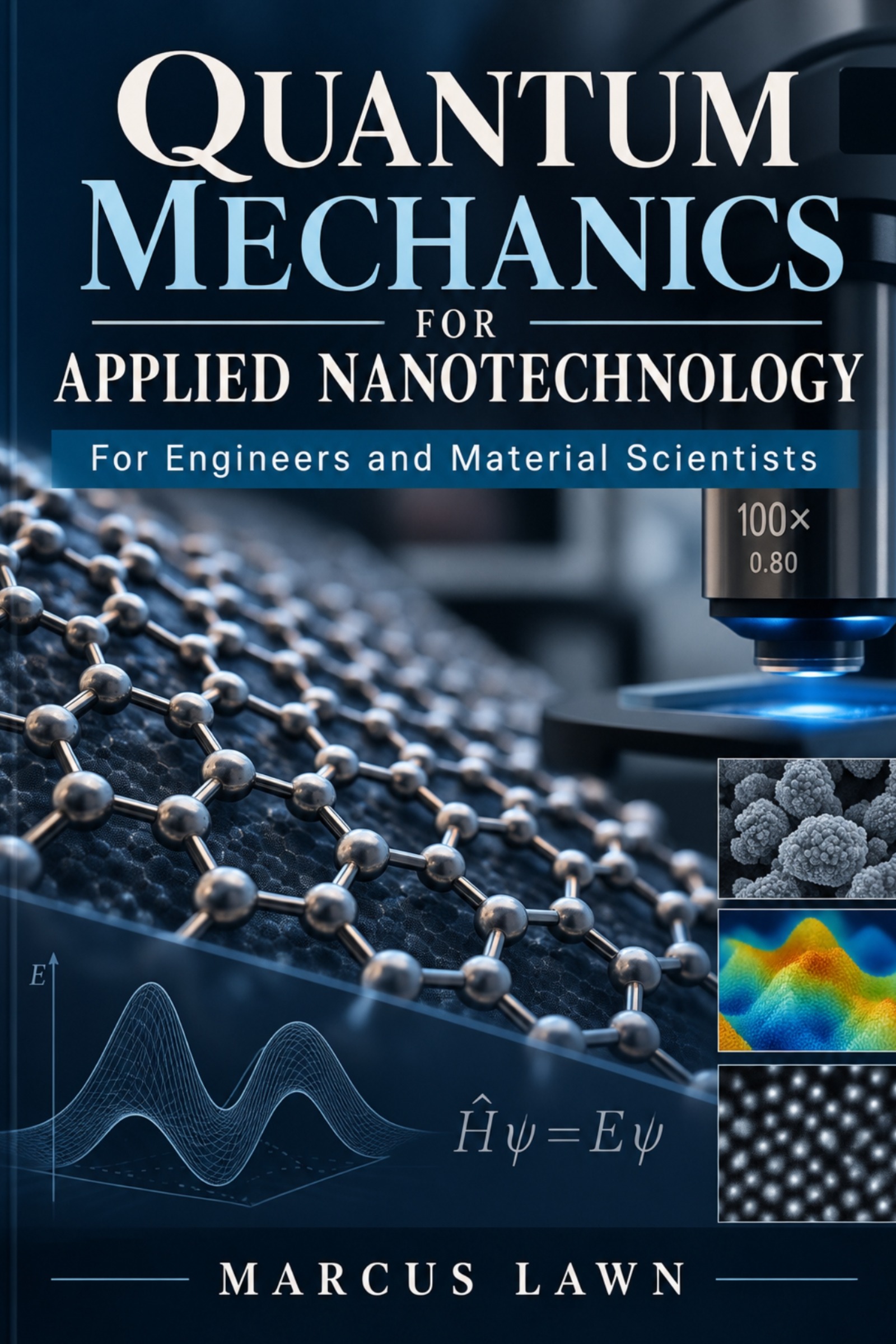
Quantum Mechanics for Applied Nanotechnology
For Engineers and Material Scientists
by Marcus Lawn
Sign in is required at checkout. You can add to cart anytime.
About this book
Quantum mechanics as a working engineering tool — not a historical tour.
A gate dielectric leaks far more current than any classical model predicts. A batch of nanocrystals shifts color when the synthesis runs two minutes long. A narrow constriction conducts in steps instead of a smooth curve. At the nanoscale the old rules quietly stop working, and the engineer who has to explain the result needs quantum mechanics as a practical instrument — with enough rigor to be trusted when a design depends on it.
Quantum Mechanics for Applied Nanotechnology is a complete, self-contained course written for people who build, characterize, and model things at the nanoscale. It assumes calculus, differential equations, linear algebra, and introductory physics — and no previous exposure to quantum mechanics. Twenty-three chapters take you from matter waves and the Schrödinger equation through perturbation theory, spin, identical particles, band theory, density operators, and open quantum systems, then put that machinery to work on heterostructures, quantum cascade lasers, spintronic memory, high-electron-mobility transistors, molecular junctions, qubits, and quantum sensors.
Every topic opens with something observable — the size-tuned glow of a quantum dot, the exponential current–distance curve of a tunneling microscope, the decoherence of a qubit — and the theory is developed only as deeply as that question requires. Then the book returns to the device with numbers.
Inside the book
Twenty-three chapters in six parts, from matter waves to quantum technologies
Worked examples in every section using real material parameters — GaAs, silicon, InAs, GaN, CdSe, graphene, MoS2 — with units carried through every step
Guided exercises placed beside the text they support, so rigorous readers can verify every derivation while the main narrative stays fluent
Engineering Insight notes linking the physics to fabrication tolerances, device performance, metrology, and reliability
Key Results summaries plus conceptual, derivation, and design problems closing every chapter
More than forty figures, each computed directly from the equations in the text
Appendices of physical constants, a mathematical toolkit, representative materials data, and further reading
Who it is for
Electrical, mechanical, chemical, and materials engineers entering nanotechnology, semiconductor devices, photonics, or quantum technology. Advanced undergraduates and first-year graduate students who need a first course that is rigorous and practical at once. Researchers who want a clear route from the postulates of quantum mechanics to the models used in device simulation and materials design.
Quantum mechanics has a reputation for strangeness. For the engineer, its most important property is reliability: the same few principles predict the color of a nanocrystal, the leakage of a gate, the conductance of a molecule, and the lifetime of a qubit. This book makes those principles yours.
Scroll up and click Add to Cart to start building with the physics that actually governs the nanoscale.
Secure checkout. After purchase it’s yours forever — read in your browser on any device.