
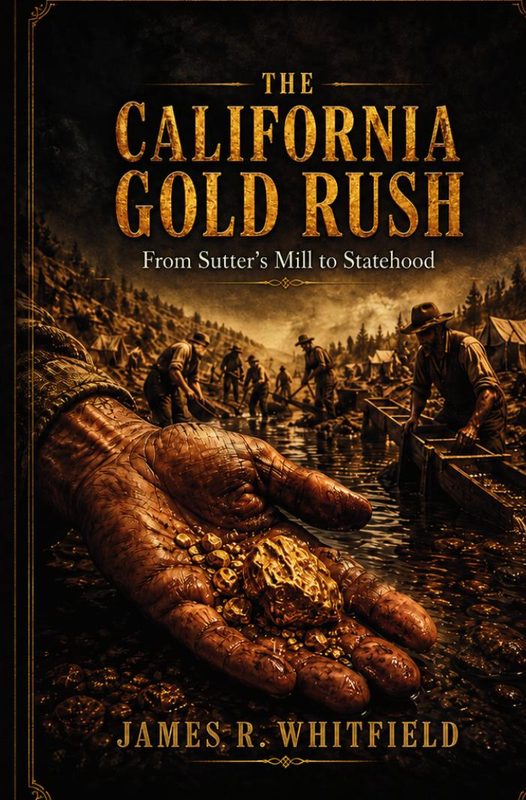
THE CALIFORNIA GOLD RUSH
From Sutter's Mill to Statehood
by James R. Whitfield
Sign in is required at checkout. You can add to cart anytime.
About this book
On the morning of January 24, 1848, James Marshall bent over the cold tailrace of an unfinished sawmill on the American River and picked a pea-sized flake from the gravel. "Boys," he told his crew, "I believe I have found a gold mine." That flake now sits in a small case at the Smithsonian, the same size as a wedding ring. It ended one world and began another.
This California Gold Rush history follows the Forty-Niners from the secret kept for less than two months to Sam Brannan running through San Francisco with a quinine bottle of gold dust, to the 300,000 people who came from Guangdong, Sonora, Valparaiso, and every American state. It tracks John Sutter, who foresaw his own ruin and died broke in Washington in 1880, and Mariano Vallejo, who lost nearly everything to American squatters. This Gold Rush history book of the American West refuses the schoolbook telling and the easy myth alike.
Inside this California Gold Rush history book:
- The discovery at Sutter's Mill 1848 - the unimpeachable diary entry of Mormon Battalion veteran Henry Bigler and Sutter's nitric-acid test that confirmed twenty-three-carat gold
- How the Forty-Niners actually traveled - around Cape Horn, across the plains, and through the fever of the Isthmus of Panama, in the largest voluntary migration to that point in human history
- The diggings and the boomtowns - placer mining with pan and rocker at Coloma, Hangtown, and Mokelumne Hill, and the leap to hard-rock mining on the Mother Lode
- The people the legend erased - Chinese miners at Gum Saan, the Foreign Miners' Tax aimed at Chilean and Mexican cuadrillas, African American argonaut Peter Brown buying his freedom with diggings gold, and the women who turned camps into towns
- The darkest ledger of the American West - the state-funded killing that cut California's Indigenous population from 150,000 to under 30,000, with the legislature's own approved budgets
- Frontier justice and statehood - Fort Gunnybags, the 1856 Vigilance Committee, the 1849 Constitutional Convention, and free-state California in the Compromise of 1850
- What the Gold Rush built and broke - banking, agriculture, the Transcontinental Railroad, hydraulic mining's ruined salmon rivers, and the road to the Civil War
Most who came did not strike rich. Many died. This California Gold Rush history holds both truths at once: the rush built modern California and financed an empire, and it accomplished a documented genocide. It is the human scale of the rush, the man with a pan in cold water and the Maidu woman whose village was burned by men paid by the state, that this account of the American West insists on recovering.
For readers of H. W. Brands's The Age of Gold and Susan Lee Johnson's Roaring Camp.
Secure checkout by Stripe. After purchase it’s yours forever — in your browser on any device.