
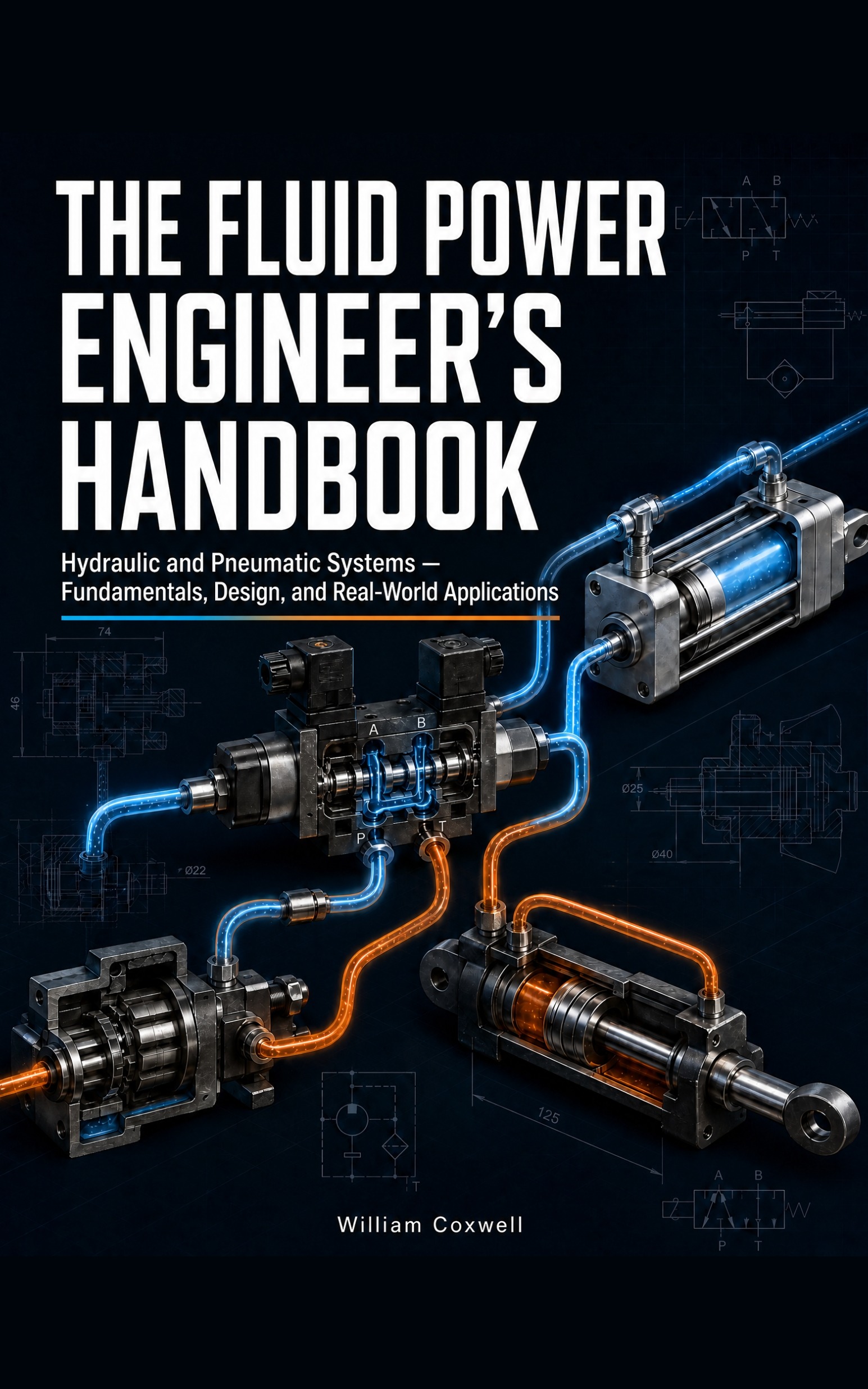
The Fluid Power Engineer's Handbook
Hydraulic and Pneumatic Systems — Fundamentals, Design, and Real-World Applications
by William Coxwell
Sign in is required at checkout. You can add to cart anytime.
About this book
If you have ever opened a hydraulic schematic and felt uncertain where to begin—or consulted a component catalog without a clear framework for evaluating what you were selecting—you are not alone. Fluid power is embedded in nearly every sector of modern industry, yet it receives surprisingly little structured treatment in engineering education. The result is a widely shared gap: engineers and students who know Pascal's law in isolation but lack the coherent system-level understanding needed to analyze, design, specify, or troubleshoot real hydraulic and pneumatic installations.
Hydraulics and Pneumatics: Fundamentals, Components, and Industrial Applications was written to close that gap. Covering both hydraulics and pneumatics within a single, structured text, the book derives every component relationship from its governing physics before applying it to real circuit analysis and system design — because an engineer who understands where the equations come from can adapt them to new problems, not just substitute numbers into a formula.
By working through this book, you will be equipped to:
• Apply Pascal's law, the continuity equation, Bernoulli's equation, and the orifice equation to real hydraulic circuit calculations, with full unit tracking at every step.
• Select, size, and compare hydraulic pumps, cylinders, motors, control valves, and conductors using the governing equations and systematic selection methodology.
• Analyze pneumatic systems using gas law calculations, design compressed air distribution networks, and size pneumatic actuators and valves using the flow factor method.
• Read, interpret, and draw hydraulic and pneumatic circuit diagrams using ISO 1219-1 graphical symbols — the international standard used in industry worldwide.
• Design complete fluid power systems, including reservoir sizing, accumulator sizing, multi-actuator circuits, and heat exchanger selection.
• Understand electrohydraulic and electropneumatic control — proportional valves, servo valves, closed-loop position control, and PLC ladder logic for fluid power sequences.
• Apply ISO 4413, ISO 4414, and structured troubleshooting methodology to maintain, commission, and diagnose faults in operating systems.
The book spans fifteen chapters across four structured parts: physical foundations, the full hydraulics sequence, the full pneumatics sequence, and integration with electronic control and industrial applications. SI units are used throughout, with US customary equivalents given in parallel. Every worked example shows the complete solution path. Practice problems progress from straightforward substitution to multi-step circuit analysis, and the answer key provides not just answers but brief solution outlines.
This is a text for upper-level undergraduate engineering students in mechanical, manufacturing, industrial, aeronautical, or mechatronics programs—and an equally practical working reference for practicing engineers who need to design, specify, or troubleshoot fluid power systems in the field.
If fluid power is part of your field — or will be — this structured guide gives you the physics, the methodology, and the practical knowledge to approach it with genuine competence. Get your copy and begin building the system-level understanding that separates a confident fluid power engineer from someone who guesses.
Secure checkout by Stripe. After purchase it’s yours forever — read in your browser on any device.