
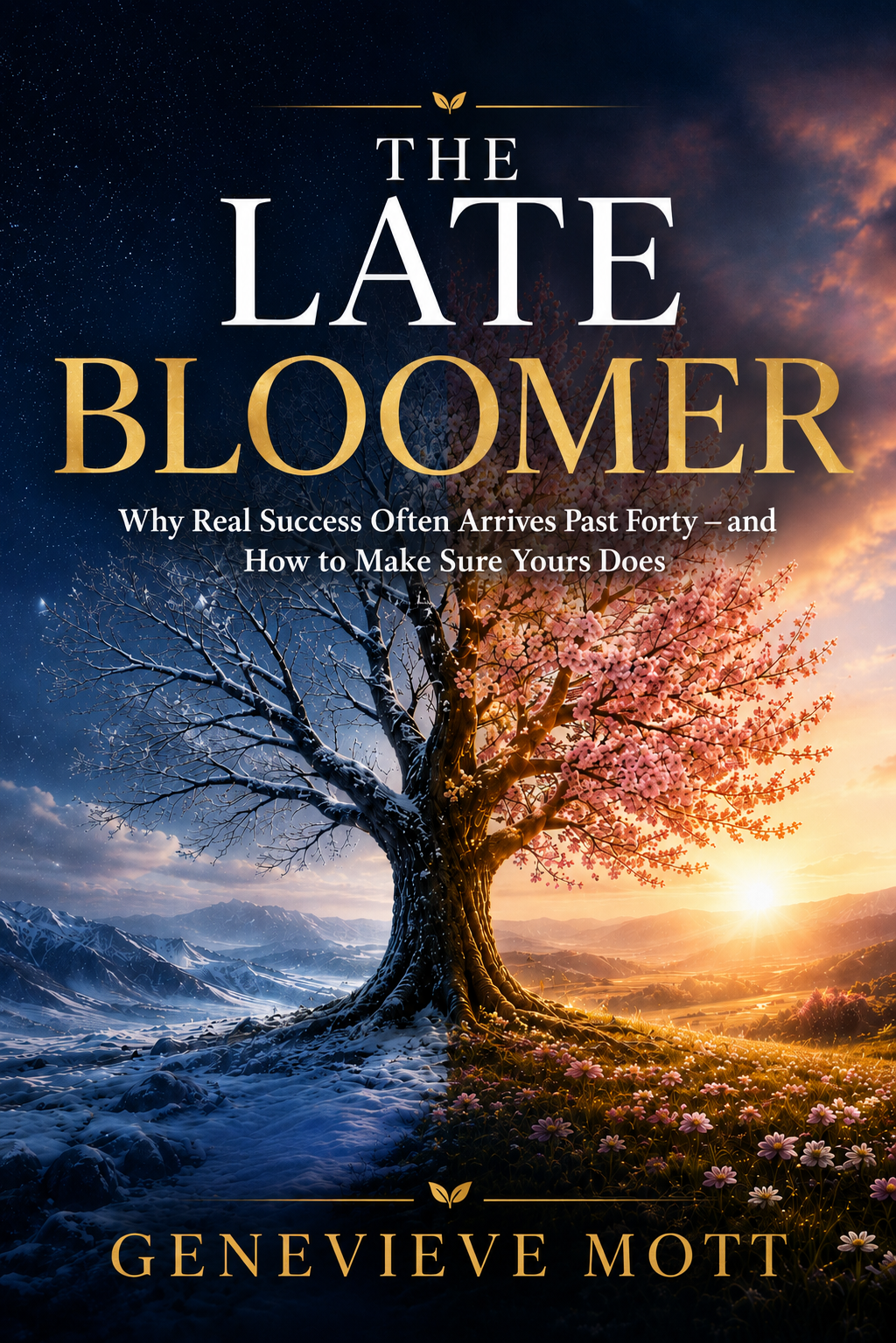
The Late Bloomer
Why Real Success Often Arrives Past Forty — and How to Make It Yours
by Genevieve Mott
Narrated by Rachel Pierce
Sign in is required at checkout. You can add to cart anytime.
Also available as 📖 ebook.
About this book
The Late Bloomer — Audiobook · Narrated by Rachel Pierce.
🎧 Listen time: 4 hours 27 minutes
Late bloomer success after 40: why real achievement, career reinvention, financial recovery, and second-act fulfillment arrive later -- and how to stop measuring yourself against the wrong timeline.In the fall of 2019, a woman named Margaret sold her first novel at age fifty-three. When Genevieve Mott asked how it felt, Margaret looked out at the slush on Forbes Avenue and said, "It feels like I finally caught up to myself." That sentence is the engine of this book -- a 22-chapter investigation into why the dominant cultural story about who succeeds, and when, is statistically wrong, and what the people who bloom after forty actually do differently.
Mott, a former paralegal who spent fifteen years as a journalist before writing her first book in her early forties, argues across research, composite portraits, and hard data that late bloomer success is not a consolation category -- it is the typical case. The average age of successful startup founders is around forty-five. Nobel laureates' prize-winning work comes overwhelmingly in their late forties and beyond. Most novels that reach real readership are written by people over forty. The "wunderkind narrative" -- the thirty-under-thirty list, the teenage chess prodigy, the hooded founder -- is a media distortion, not a description of how achievement actually unfolds. This is a book about second-act career change, financial late starts, creative late blooming, love after forty, fitness comebacks at sixty, and the particular kind of patience that compounds into a life.
Inside this late bloomer and midlife reinvention audiobook:
- The two-timeline problem -- why you have felt behind since your thirtieth birthday, and how switching from the cultural timeline to the actual human development timeline dissolves decades of low-grade anxiety
- The compounding principle -- skill, judgment, reputation, and capital all compound slowly; Chapter 3 shows exactly what this looks like across twenty years of unglamorous practice
- Late entrepreneurship data -- Chapter 6 presents the research showing a fifty-year-old is roughly twice as likely as a thirty-year-old to build a high-growth company that lasts
- Financial late start recovery -- Chapter 9 addresses the honest arithmetic of starting serious retirement savings at forty-five, what is genuinely harder, and what the late starter gets right that the early starter rarely does
- Career reinvention and second acts -- Chapters 4, 17, and 20 map the most successful second-act pattern: not the dramatic pivot, but a substantial reorientation that draws on everything already built
- Failure at midlife -- Chapter 16 rejects both the toxic positivity version of failure-as-teacher and the shame spiral, offering instead the specific relationship to setback that late bloomers develop
- The "Try this" experiments -- every chapter ends with a small practical exercise, deliberately sized for an afternoon or a week, because most of what changes a life is too small to feel like it's changing a life while it's happening
This is not a hustle book. It is not a passion-discovery book. Mott is explicit that some doors close, and she does not pretend otherwise. What she argues -- across career late bloomers, creative late bloomers, financial late starters, love after forty, fitness comebacks, and the long late life -- is that the doors most people actually care about are almost always still open, and that walking through them in your forties, fifties, or sixties is not the exception. In aggregate, across rea...
Secure checkout by Stripe. After purchase it’s yours forever — listen in your browser on any device.