
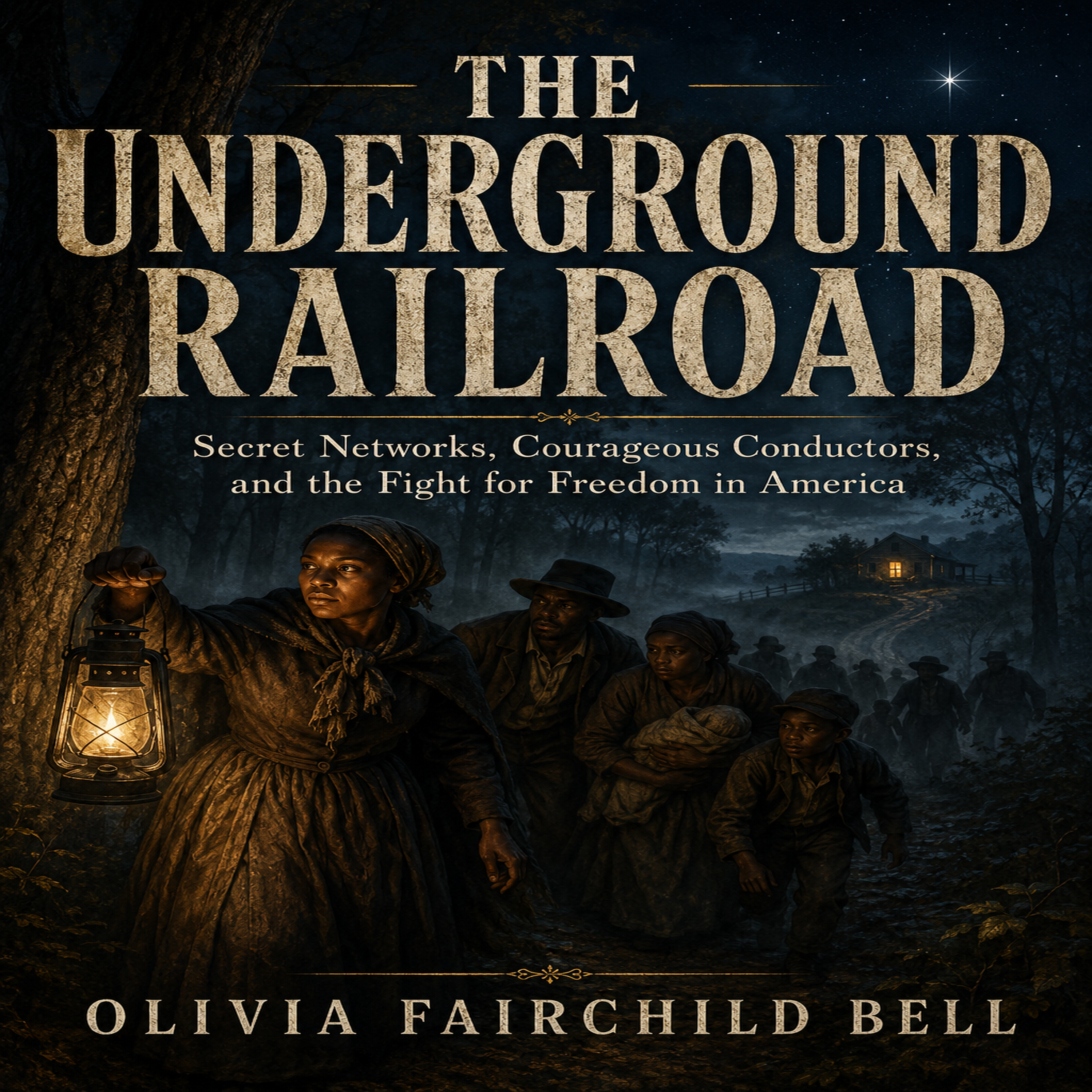
THE UNDERGROUND RAILROAD
Secret Networks, Courageous Conductors, and the Fight for Freedom in America
by Olivia Fairchild Bell
Narrated by Maya Norwood
Sign in is required at checkout. You can add to cart anytime.
About this book
THE UNDERGROUND RAILROAD — Audiobook · Narrated by Maya Norwood.
🎧 Listen time: 5 hours 37 minutes
Underground Railroad history — Harriet Tubman, Frederick Douglass, the Fugitive Slave Acts, and the secret network of conductors and freedom seekers who defied slavery across 70 years of American history.On a moonless night in 1849, Harriet Tubman waded into the Choptank River on Maryland's Eastern Shore and began walking north. Ninety miles later — hidden by Quaker farmers and free Black families whose names she was never allowed to learn — she crossed into Philadelphia. She was free. And she immediately began planning to go back.
This is the story of that return — and of the thousands who built the most audacious conspiracy of conscience in American history. Tubman, Frederick Douglass, Levi Coffin, Thomas Garrett, William Still, and John Parker — Black and white, enslaved and free — defied federal law to help between 30,000 and 100,000 people reach freedom. Bell traces this underground railroad history across twenty-four chapters, from Virginia's 1705 Slave Code through Great Dismal Swamp maroon archaeology to the network's living legacy today.
Inside this underground railroad history:
- Tubman's thirteen missions — operating on Saturday nights to delay pursuit ads, armed with a revolver, guiding ~70 freedom seekers to St. Catharines, Ontario after the Fugitive Slave Act made Northern free soil legally dangerous (Chapter 9)
- Frederick Douglass's escape — a twenty-year-old in a sailor's uniform boarding a Baltimore train with borrowed papers on September 3, 1838, emerging as the era's most powerful anti-slavery voice (Chapter 10)
- Thomas Garrett's defiance — fined $8,000 when he owned $7,500, walking out penniless and telling the judge to send every fugitive who needed a friend; he assisted 2,700 more over the next sixteen years (Chapter 12)
- Henry "Box" Brown's 27 hours — shipped Richmond to Philadelphia in a crate labeled "This side up with care," emerging to sing the psalm he'd composed in the dark (Chapter 18)
- The 1850 Fugitive Slave Act's perverse incentive — $10 for certifying a return, $5 for freedom; why this law forced the entire network to extend to Canada (Chapter 15)
- The mythology versus William Still's records — no antebellum evidence for the quilt code; Still's 649 documented cases buried in a cemetery vault; what the real history reveals about who ran the Railroad and why (Chapters 22-23)
Bell's narrative refuses comfortable myth: the Underground Railroad was a Black-centered conspiracy in which freedom seekers' courage was the essential engine. Still's case files, Garrett's fifty-one letters, Parker's rediscovered memoir, and Dismal Swamp archaeology together ground this underground railroad history in real names, real decisions, and the real prices paid from 1849 to 1865.
For listeners of the audiobook of Eric Foner's GATEWAY TO FREEDOM and Colson Whitehead's THE UNDERGROUND RAILROAD.
Secure checkout by Stripe. After purchase it’s yours forever — listen in your browser on any device.