
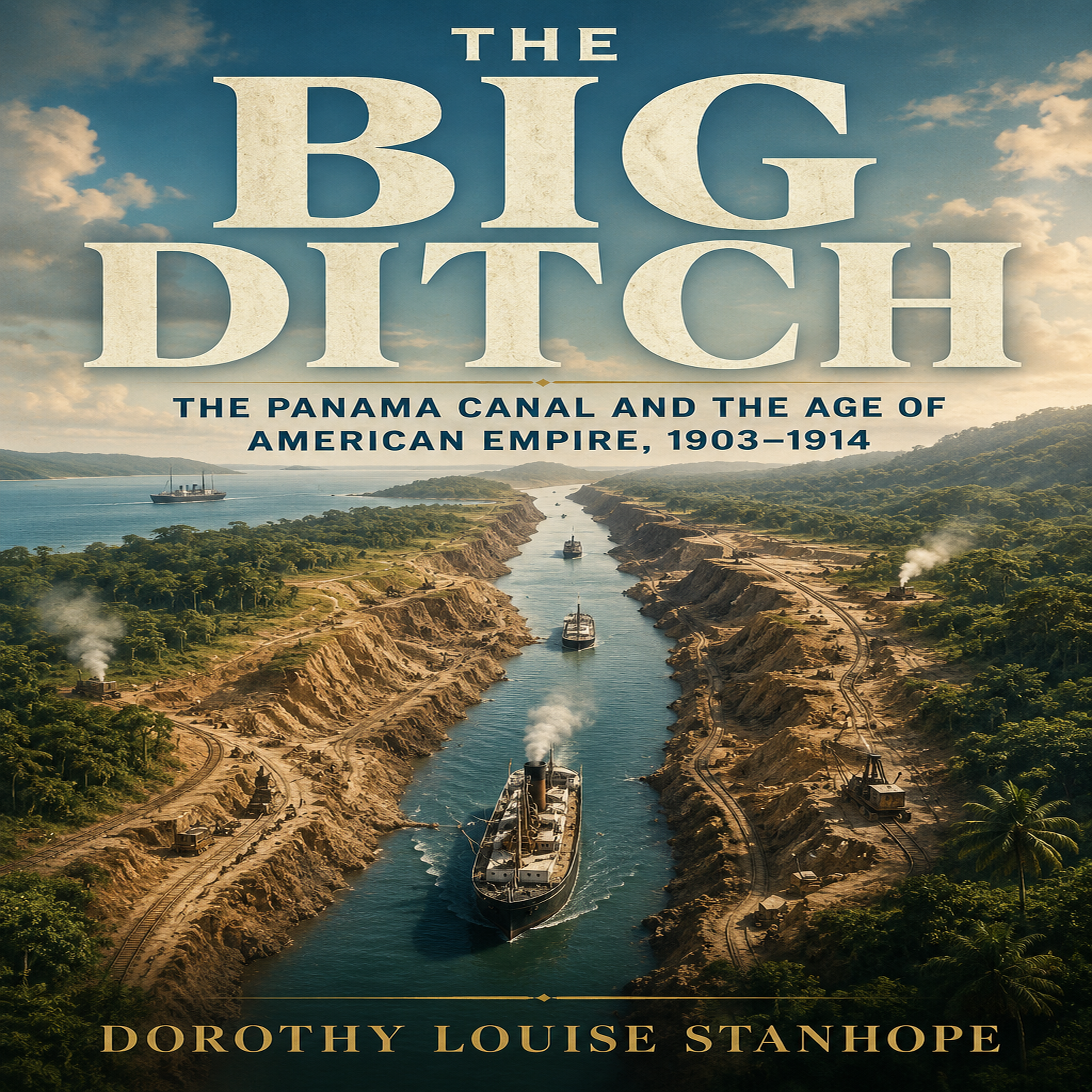
the big ditch
The Panama Canal and the Age of American Empire, 1903-1914
by Dorothy Louise Stanhope
Narrated by Eve Singh
Sign in is required at checkout. You can add to cart anytime.
Also available as 📖 ebook.
About this book
the big ditch — Audiobook · Narrated by Eve Singh.
🎧 Listen time: 5 hours 17 minutes
Panama Canal history — American empire, engineering triumph, and the human cost of the Big Ditch, 1903-1914. The complete narrative of how the United States built the canal, sponsored a revolution, and created a colonial zone.In 1880, Ferdinand de Lesseps arrived in Panama with the reputation of the man who had joined two seas at Suez. Within nine years his company had spent more than $800 million, killed an estimated 22,000 workers, and collapsed in bankruptcy and criminal fraud. De Lesseps died in 1894 with his name in ruins. The French failure left behind cleared jungle, preliminary excavations, and the question that would define American foreign policy: who would finish the canal?
Dorothy Louise Stanhope's narrative answers that across twenty-four chapters, from the 1903 Hay-Herran Treaty and Theodore Roosevelt's American-sponsored Panamanian revolution through Colonel Gorgas's mosquito-eradication campaign, Goethals's military engineering command, and the August 1914 opening — overshadowed by a war in Europe that had just begun. The book traces American empire-building at its most confident: naming the engineers who built the canal, the West Indian workers who paid the human cost, and the Panamanians whose sovereignty was subordinated to American strategic ambition.
Inside this Panama Canal history:
- The French failure — de Lesseps's sea-level design killed 22,000 workers and bankrupted in 1889, leaving excavations an American project would build on (Chapter 1)
- Roosevelt's revolution — Colombia's refusal of the Hay-Herran Treaty, American warships, and instant recognition of a new Panamanian state in 1903 (Chapters 3-4)
- Gorgas and the medical miracle — how identifying the Aedes aegypti mosquito as yellow fever's vector, proven in Cuba in 1900, transformed the isthmus from death trap to construction site (Chapter 5)
- The Silver and Gold Rolls — the canal zone's racial hierarchy: West Indian workers dying at three times the rate of American workers, building a structure whose sovereignty their descendants would reclaim (Chapters 9-11)
- The Culebra Cut — digging through the Continental Divide against slides that refilled months of excavation; official death toll 5,609 — almost certainly an undercount (Chapters 7, 12)
- The 1964 Flag Riots and the Torrijos-Carter Treaties — how Panamanian nationalism, born in colonial resentment, forced the handover on December 31, 1999 (Chapters 19-20)
The canal that opened in 1914 was built on a staged coup and constructed by a racially stratified workforce whose West Indian laborers are still being written back into the story. Stanhope's Panama Canal history recovers both the engineering triumph and the imperial cost.
For listeners of the audiobook of David McCullough's THE PATH BETWEEN THE SEAS and Matthew Parker's HELL'S GORGE.
Secure checkout by Stripe. After purchase it’s yours forever — listen in your browser on any device.