
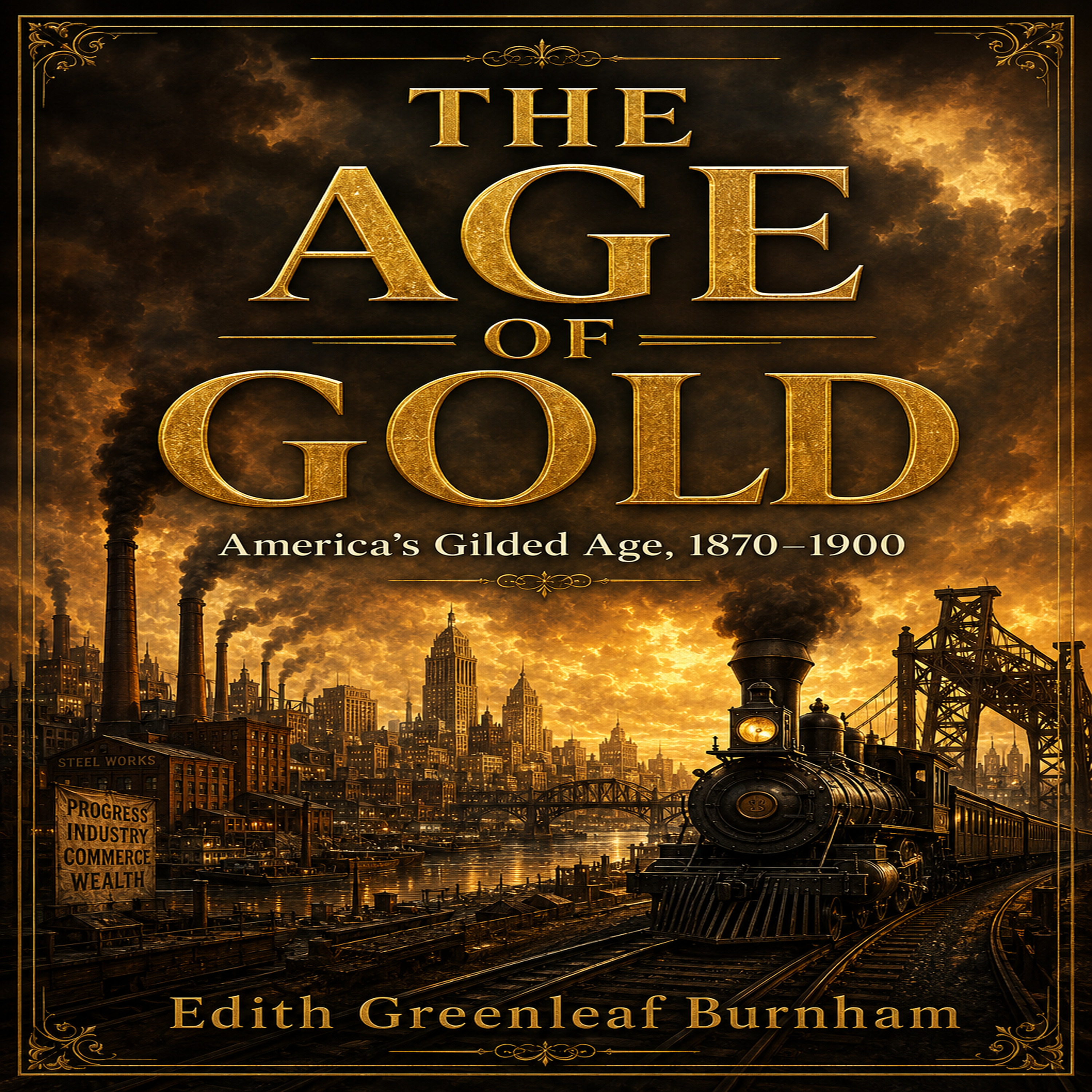
The age of gold
America's Gilded Age, 1870–1900
by Edith Greenleaf Burnham
Narrated by Ethan Sloan
Sign in is required at checkout. You can add to cart anytime.
About this book
The age of gold — Audiobook · Narrated by Ethan Sloan.
🎧 Listen time: 5 hours 7 minutes
The complete narrative history of America's Gilded Age — Vanderbilt, Rockefeller, Carnegie, J.P. Morgan, the robber barons, the Haymarket bomb, and the birth of modern America, 1870-1900.On May 24, 1883, President Chester Arthur stood at the Brooklyn Bridge as 150,300 pedestrians crossed in a single day. The bridge cost $15 million and killed twenty-seven men — including engineer John Roebling, who died of tetanus after a ferry crushed his foot during the survey work. Ten blocks east, families of eight slept in two-room tenements without windows, at densities exceeding 1,000 people per acre. Mark Twain coined the era's name for a reason: not golden, but gilded — brilliant on the surface, corrupt and suffering beneath.
This is the full story of that America — of Cornelius Vanderbilt, John D. Rockefeller, Andrew Carnegie, J.P. Morgan, Jay Gould, Jacob Riis, Jane Addams, Mary Elizabeth Lease, and William Jennings Bryan — across twenty-four chapters in six parts. Historian Edith Greenleaf Burnham traces the complete arc of the Gilded Age from the end of Reconstruction through the election of Theodore Roosevelt, covering the robber barons, the immigrant city, the Populist revolt, Jim Crow, and the reform movements that shaped the Progressive Era.
Inside this Gilded Age history:
- The Erie War — Jay Gould, Jim Fisk, and Daniel Drew printed 100,000 shares of watered stock and fled to Jersey City with $7 million, then paid $500,000 to bribe the Albany legislature to legalize the fraud (Chapter 1)
- Rockefeller's Cleveland Massacre — Standard Oil's secret railroad rebates bought out 22 of Cleveland's 26 independent refineries in six weeks in 1872; Ida Tarbell's 19-installment McClure's series brought it to public reckoning (Chapter 2)
- The Great Upheaval and Haymarket — 350,000 workers striking for the eight-hour day in 1886, a dynamite bomb killing seven police officers in Haymarket Square, and four hangings that broke the Knights of Labor's 700,000-member peak (Chapter 8)
- The Populist revolt — Mary Elizabeth Lease giving 160 speeches in Kansas to "raise less corn and more hell," James Weaver winning 22 electoral votes in 1892, and Bryan's "cross of gold" speech at the Chicago convention in 1896 (Chapters 10-11)
- Hull House and the Social Gospel — Jane Addams at 800 South Halsted Street with 19 nationalities, Florence Kelley surveying 645 garment workshops, and the Illinois Factory Act that made Kelley America's first female industrial regulator (Chapter 12)
- The Pullman Strike and its aftermath — Eugene Debs, 250,000 workers on twenty-nine railroads, a federal injunction issued under the Sherman Antitrust Act, and the six prison months that turned Debs into America's leading socialist (Chapter 22)
The Gilded Age produced Carnegie's libraries and the Homestead dead, the transcontinental railroad and the dispossession that built it. Burnham delivers the complete picture — achievement and exploitation, genius and corruption — and the reform tradition that the era's contradictions made inevitable.
For listeners of the audiobook of T.J. Stiles's THE FIRST TYCOON and Ron Chernow's TITAN.
Secure checkout by Stripe. After purchase it’s yours forever — listen in your browser on any device.