
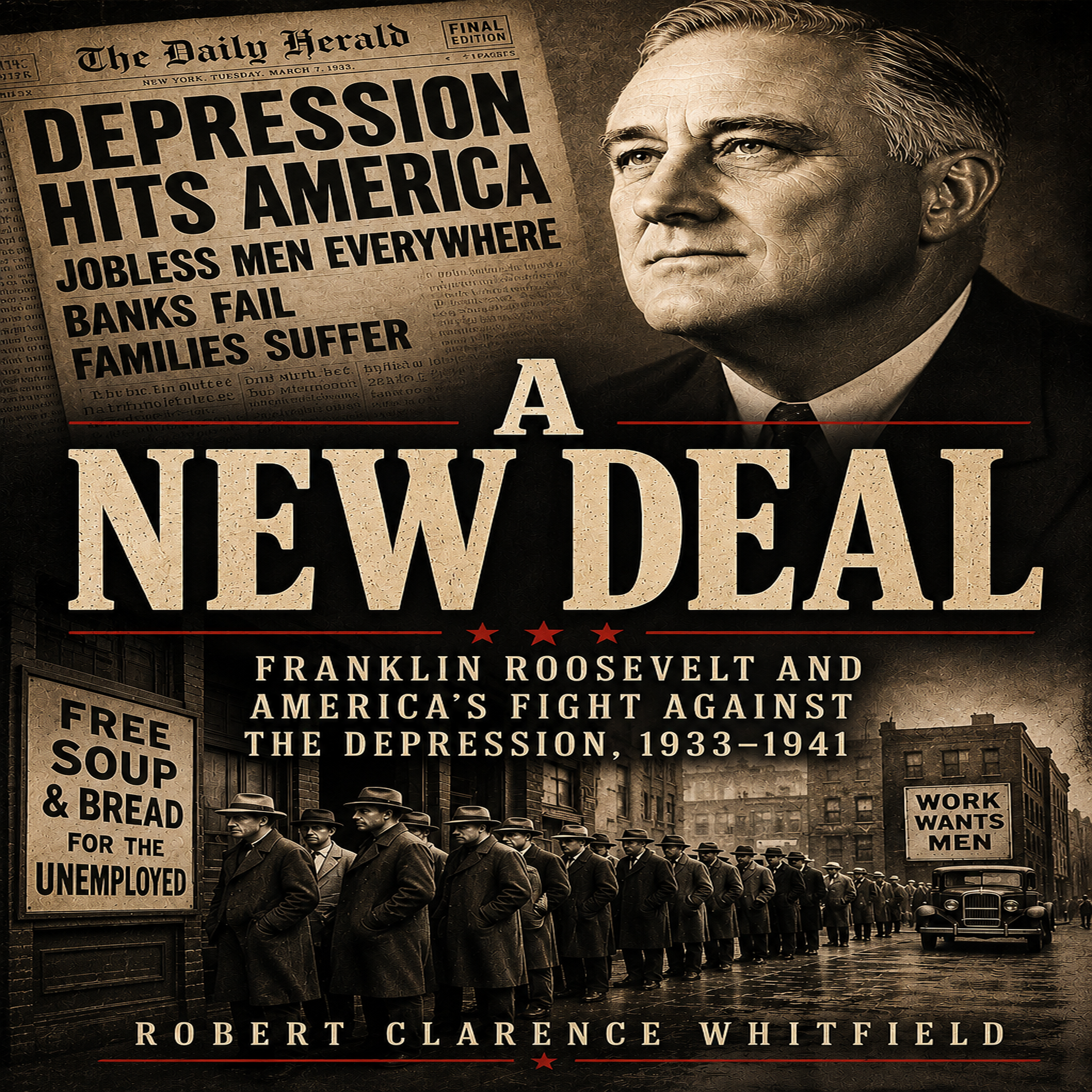
A NEW DEAL
Franklin Roosevelt and America's Fight Against the Depression, 1933-1941
by Robert Clarence Whitfield
Narrated by Kate Carlsson
Sign in is required at checkout. You can add to cart anytime.
About this book
A NEW DEAL — Audiobook · Narrated by Kate Carlsson.
🎧 Listen time: 5 hours 27 minutes
The definitive narrative history of FDR and the New Deal — Franklin Roosevelt, the Great Depression, Social Security, the WPA, and the complete story of how America's federal government was remade, 1929-1941.On the morning of March 4, 1933, Franklin Roosevelt placed his hand on a Dutch Reformed Bible and swore to preserve, protect, and defend the Constitution. Nine thousand banks had closed since his election. Unemployment had climbed to twenty-five percent. Industrial output had fallen by half from its 1929 peak. The man who stepped to the microphone sounded like someone who was not afraid. In 1933 America, that sound was revolutionary.
In this complete New Deal history, historian Robert Clarence Whitfield traces the full arc of the Roosevelt years — from the market crash of October 1929 and Herbert Hoover's failure of nerve, through the Hundred Days, the alphabet agencies, the Second New Deal's social insurance legislation, and the conservative coalition that halted reform in 1938. At the center stand Franklin Roosevelt, Eleanor Roosevelt, Harry Hopkins, Frances Perkins, and the millions of ordinary Americans whose lives the New Deal remade — told in their own voices, grounded in the primary record, and unflinching about the program's racial exclusions.
Inside this Great Depression history:
- The Bank Holiday and the First Fireside Chat — Roosevelt restored confidence in a week: the Emergency Banking Act signed, examined banks declared solvent, deposits exceeding withdrawals for the first time in months (Chapter 5)
- The Hundred Days and the alphabet agencies — NRA, AAA, CCC, FERA: 99 days of the most concentrated lawmaking in American history (Chapter 6)
- Social Security and the Wagner Act — Ida May Fuller's first monthly check of $22.54 on January 31, 1940, and the Wagner Act's legally protected collective bargaining (Chapters 9, 22)
- The WPA and the cultural New Deal — 8.5 million workers at its peak, including the writers, painters, and theatre workers who produced a government-funded American cultural record (Chapter 10)
- Black Americans and the New Deal's limits — Social Security's deliberate exclusion of domestic and agricultural workers to preserve the South's racial wage structure, and what Eleanor Roosevelt did about it (Chapter 18)
- Did the New Deal end the Depression? — unemployment was still at ten percent eight years in; the honest assessment of what the programs achieved and why war mobilization succeeded where the New Deal fell short (Chapter 21)
The New Deal left behind Social Security, the FDIC, the SEC, the NLRB — institutions that still govern American life. It also left behind a question only partially answered: what does democratic government owe its people when prosperity fails? This Franklin Roosevelt biography and Great Depression history tells the story of the incomplete, indispensable answer Roosevelt's twelve years produced.
For listeners of the audiobook of David Kennedy's FREEDOM FROM FEAR and Arthur Schlesinger Jr.'s THE AGE OF ROOSEVELT.
Secure checkout by Stripe. After purchase it’s yours forever — listen in your browser on any device.