
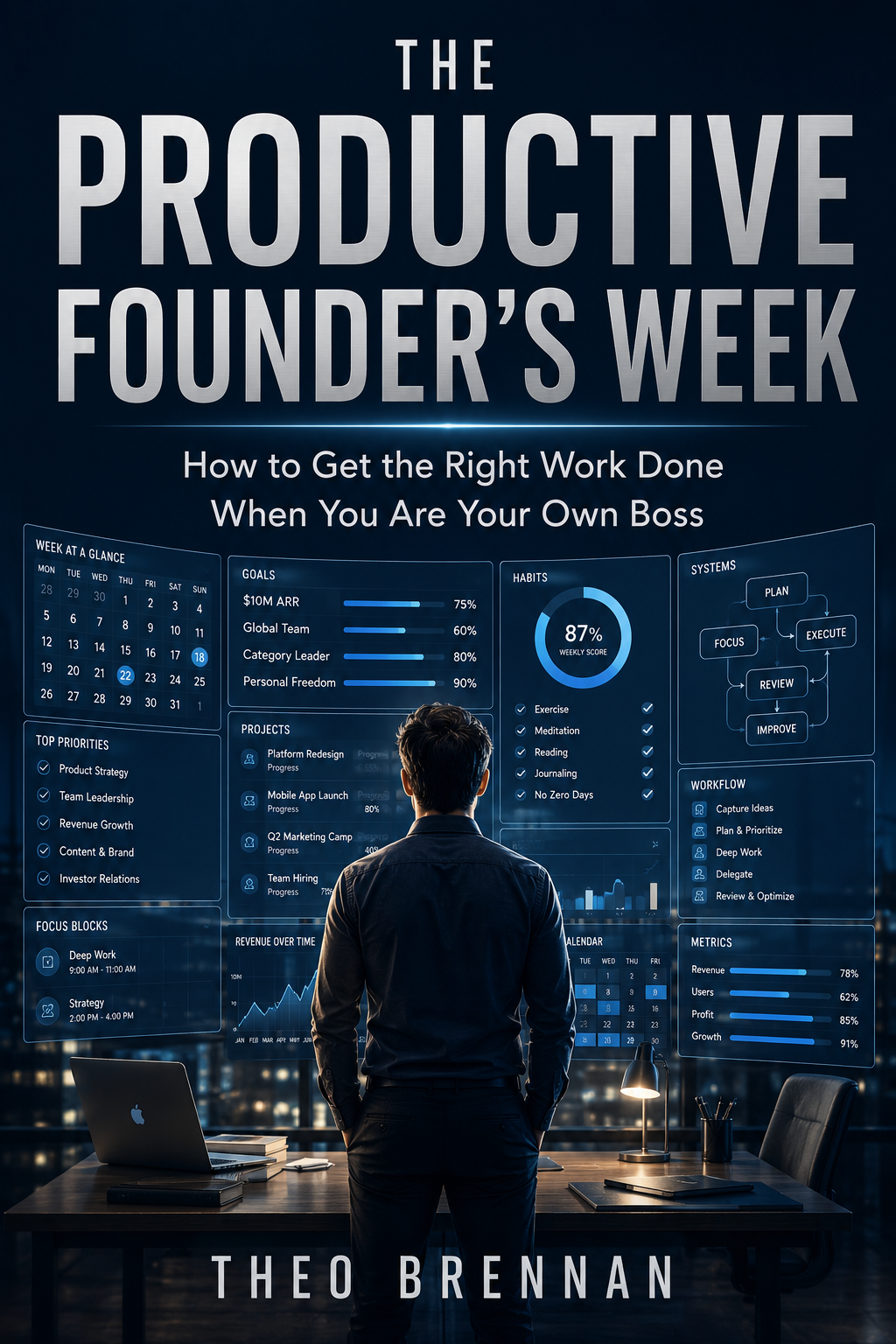
The Productive Founder's Week
How to Get the Right Work Done When You Are Your Own Boss
by Theo Brennan
Sign in is required at checkout. You can add to cart anytime.
About this book
A founder named Priya, who runs a four-person product studio, sent Theo Brennan a message one Friday: "I read three productivity books this month and I'm getting less done than I was in March." The books weren't bad. They were written for someone with a manager, a team standing up at nine, a calendar populated by other people, and a paycheck that arrived whether or not she shipped anything. Priya had none of that. When you are self-employed, Monday is a blank field, and if you don't decide what to do this morning, no one else will decide for you.
This is a time management book for founders that throws out the corporate playbook. Brennan has been self-employed for twelve years and has watched roughly four hundred founders work through their weeks in detail. The difference between the ones thriving and the ones exhausted is rarely talent or luck. It is almost always structure: three to five weekly practices they can name, protect, and run without negotiation. The book is built on hard-earned opinions — the calendar is the source of truth, not the to-do list; a real week has three priorities, not ten; deep work happens in two-hour blocks, not eight-hour heroics; energy management beats time management; and rest is a load-bearing input, not a reward. Every chapter ends with a concrete "Try this" experiment you can run this week.
Inside this founder productivity book:
- Three priorities, not ten — Why ten priorities is no priorities, and how to design a week around three real ones with one two-hour deep work block assigned to each (Chapters 2 and 7)
- The calendar that actually holds — Treating the calendar as a commitment instead of a wish list, so the work that compounds gets a time and the rest stops pretending it will happen (Chapter 3)
- The two-hour deep work block — Run a single protected block Monday morning, defended like a religious observance, then repeat Tuesday until you can see what your whole week could be (Chapter 7)
- Saying no with no boss to hide behind — How to protect three time blocks a week from a world trying to take them when there is no manager to blame (Chapter 6)
- The Friday review that produces better Mondays — A forty-five-minute, four-section review run Friday afternoon so the week's transition is already done before Monday (Chapter 10)
- Energy management beats time management — The six leveraged inputs (sleep, food, movement, sunlight, social connection, recovery) most self-employed founders systematically under-invest in (Chapter 12)
- Rest, burnout recovery, and the hard day — How to save a day that's falling apart, recover from burnout, and treat rest as productive (Chapters 15, 16, and 19)
This is not a book about more tools or a more sophisticated task system. Most founders need fewer tools and a calendar that holds. Over a year, the compounding power of boring, well-structured weeks is what takes a business from where it is now to where you want it in two years — six hours of protected deep work a week, repeated, is enough to grow a business. The week, as Brennan writes, is the unit.
For readers of Cal Newport's Deep Work and Oliver Burkeman's Four Thousand Weeks: Time Management for Mortals.
Secure checkout. After purchase it’s yours forever — read in your browser on any device.