
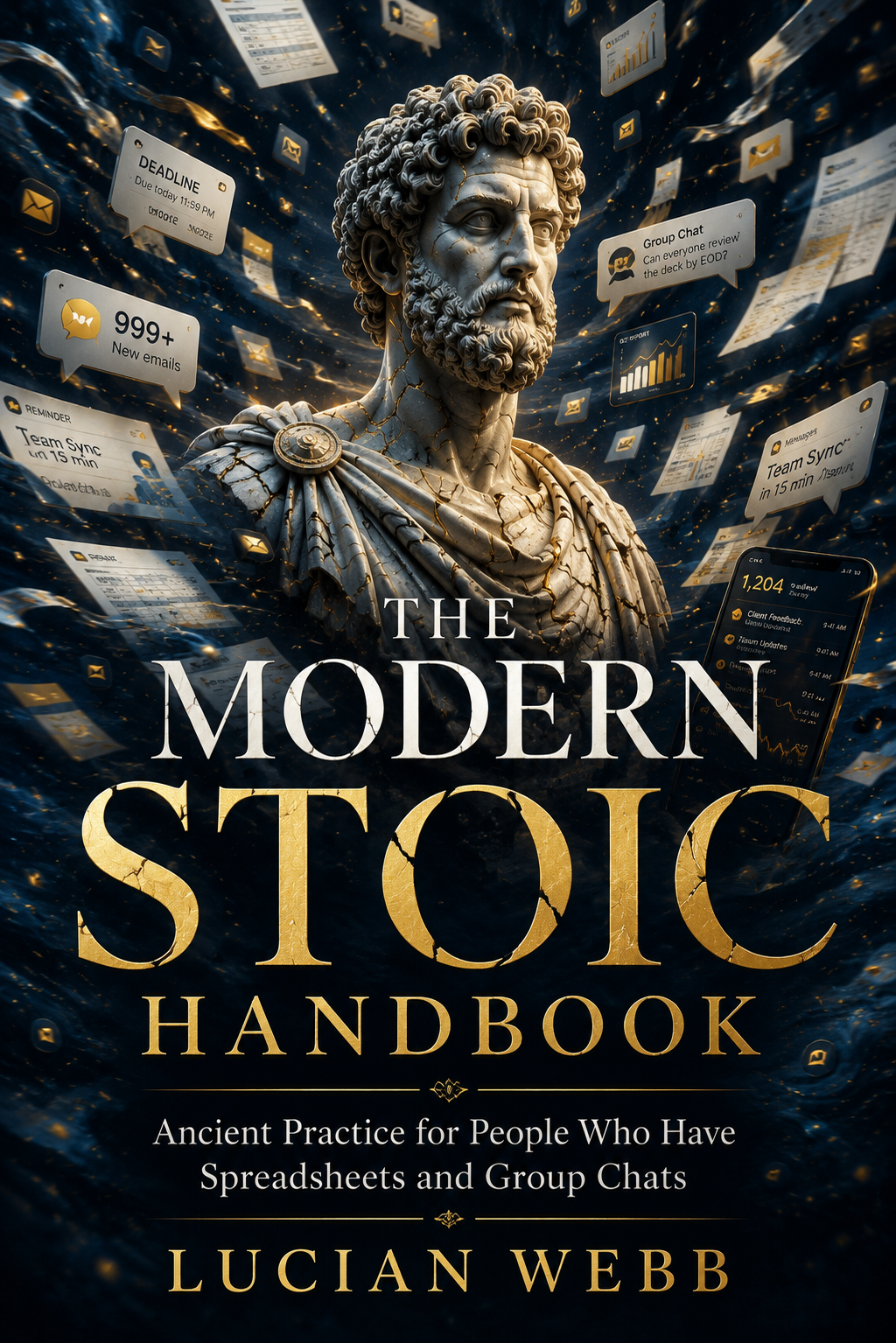
The Modern Stoic Handbook
Ancient Practice for People Who Have to Function in the Modern World
by Lucian Webb
Sign in is required at checkout. You can add to cart anytime.
About this book
A man Lucian Webb used to coach kept a Marcus Aurelius quote pinned to his desktop and read it every morning. He also screamed at his assistant twice a week and could not sit in a room with his sister for forty minutes. "When I asked him what the quote meant in practice," Webb writes, "he gave me a paragraph of vocabulary and no behavior." That gap between what we know and what we do is the gap this book on Stoic philosophy was built to close.
Written by a classicist who taught Marcus Aurelius, Epictetus, and Seneca in the original Greek and Latin for twenty-three years before becoming an executive coach, this modern Stoicism handbook strips the philosophy of its gym-shirt costume and returns it to working order. Across twenty short chapters, Webb covers the one dichotomy of control, the daily examination, the view from above, the premeditation of adversity, anger as the most expensive emotion, fear, death, money and status, difficult people, aging, comparison in the algorithmic age, and grief. Every chapter ends with a single "Try this" exercise you can run this week. This is Stoic philosophy for everyday life, not a quote book you could buy for nine dollars at an airport.
Inside this practical Stoicism handbook:
- The one dichotomy of control — the single distinction the whole philosophy hangs from, with the pen-and-paper exercise Webb uses with coaching clients to sort what is up to you from what is not
- The daily Stoic practice that influencers skip — the morning preparation and the evening examination, the unglamorous private work that does not photograph well but actually changes behavior
- Anger, the most expensive emotion — why Seneca treated anger as a temporary madness, and how to interrupt it before it sends the email you will regret
- Stoicism for difficult people and difficult relationships — handling the passive-aggressive 8:47 a.m. email, the teenager who will not look up, the spouse whose moods are not yours to operate
- Death, grief, and aging without bitterness — the topics modern culture skips, met with the Stoic claim that the grief is not less, the grief is honest
- Comparison in the algorithmic age — applying ancient Stoic philosophy to the hostile new conditions of attention, status, and the feed
- A reader's guide to the source texts — where to start with Epictetus, Marcus Aurelius, and Seneca, which translations to trust, and a year of practices to keep going after the last page
This is not a philosophy that promises to make you invulnerable or to fix conditions you did not choose. It is practical Stoicism that promises a better relationship with them: steadier, more honest with yourself, less governed by your moods, less hostage to the moods of others. The practices are simple to describe and difficult to do, and the difficulty is the whole point.
For readers of Ryan Holiday's The Daily Stoic and Donald Robertson's How to Think Like a Roman Emperor.
Secure checkout. After purchase it’s yours forever — read in your browser on any device.