
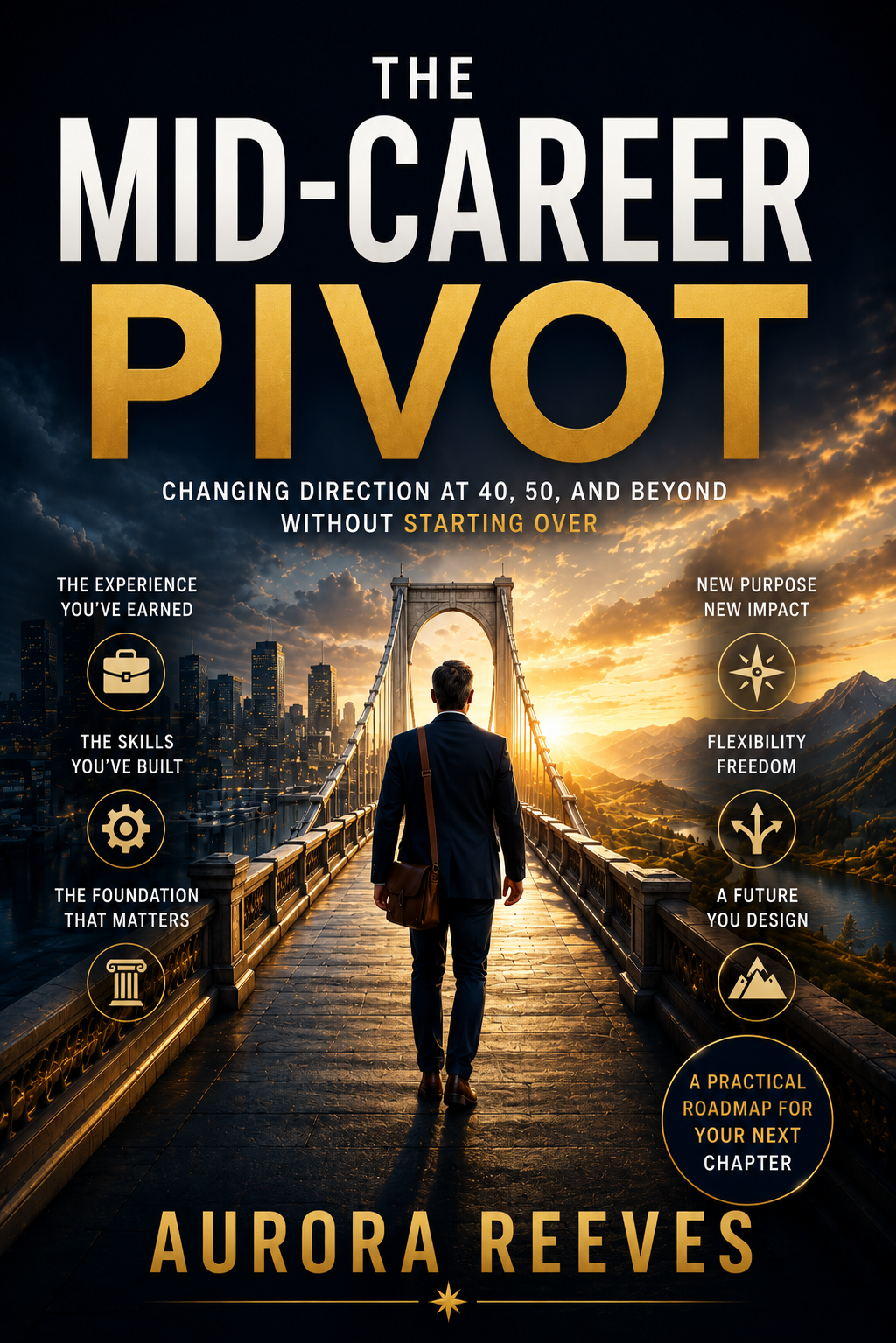
The Mid-Career Pivot
Changing Direction at 40, 50, and Beyond Without Starting Over
by Aurora Reeves
Sign in is required at checkout. You can add to cart anytime.
About this book
A litigation partner sat at her kitchen island, two glasses of pinot grigio into a Tuesday, and said the thing she had been holding for a decade: "I think I might be done." Not done with her marriage, not done with her kids. Done with the firm she had given seventeen years to, done with the 6:14 a.m. train. Aurora Reeves has now seen that expression on roughly four hundred faces. She wrote this book for the embarrassment that comes with it — the sense that wanting a different career at fifty is a luxury problem you should be old enough to know better than to have.
This career reinvention guide is for the person between forty and seventy who has a long-standing professional identity and is feeling the quiet signal: not this, not for the next twenty years. Reeves refuses the slogans. She will not tell you to follow your passion or that it is never too late, because those lines do not survive contact with a real mortgage statement. Instead she lays out the actual physics of changing careers at 40, 50, and beyond: the financial runway most people miscalculate by a factor of two, the eight things a mid-career pivoter is really carrying into the move, and the specific friction of being the oldest person in the interview room. This is not another life-design philosophy book. It is an operating manual for the professional who must change careers while carrying a mortgage, a 401(k), a spouse, and a reputation that does not automatically transfer.
Inside this mid-career pivot guide:
- Burnout vs. pivot-restlessness — How to tell whether rest will fix the problem or whether the vector is simply wrong, using the Sunday tightness, the conference-room daydream, and the client who took two weeks off and came back feeling worse
- The financial runway most people miscalculate — A six-step calculation covering transition expenses, the health-insurance ambush, the 401(k) trap, and why a $100,000 withdrawal at fifty-two really costs closer to $300,000 in lost compounding
- Skills that travel and skills that do not — A four-bucket framework separating domain knowledge, craft skills, meta-skills, and dispositional capacities, and how to find the overlap that becomes your highest leverage in the new field
- The credibility problem and how to solve it — Why credentials are often not the bottleneck, and how one economist built public credibility before he had a single job in his new field by writing pieces the field itself started sharing
- The oldest-in-the-room interview — What younger hiring managers are actually worried about (not what most pivoters assume), and 90-second prepared answers for "Why now?" "Why this role?" and "Why you over someone with experience in our field?"
- Salary negotiation when you are new to the field — Why anchoring on your old salary almost always backfires, and the exact language that signals realistic expectations without leaving money on the table
- Going back to school at 50, pivoting after a layoff at 50, starting a business at 55 — When each is the right call, when it is not, and how to read the difference before you have paid the tuition deposit
- A full pivot planning workbook, money-math appendix, and conversation scripts — Including a letter to read in a hard week and sample five-year case studies from clients who pivoted well and from those whose first attempt failed before the second one landed
The book is designed to be slow: read a chapter, do the "Try this" exercise, let it work on you for a day. Reeves is equally willing to tell you not to pivot — some of her most peaceful coaching conversations end with a client realizing they wanted a different relationship with the career they have, not a different career. The mid-career pivot is not a do-over. It is a redirection, and this is the practical guide to making it without lighting your life on fire to do it.
For readers of Herminia Ibarra's Working Identity: Unconventional Strategies for Reinventing Your Career and Arthur Brooks's From Strength to Strength: Finding Success, Happiness, and Deep Purpose in the Second Half of Life.
Secure checkout. After purchase it’s yours forever — read in your browser on any device.