
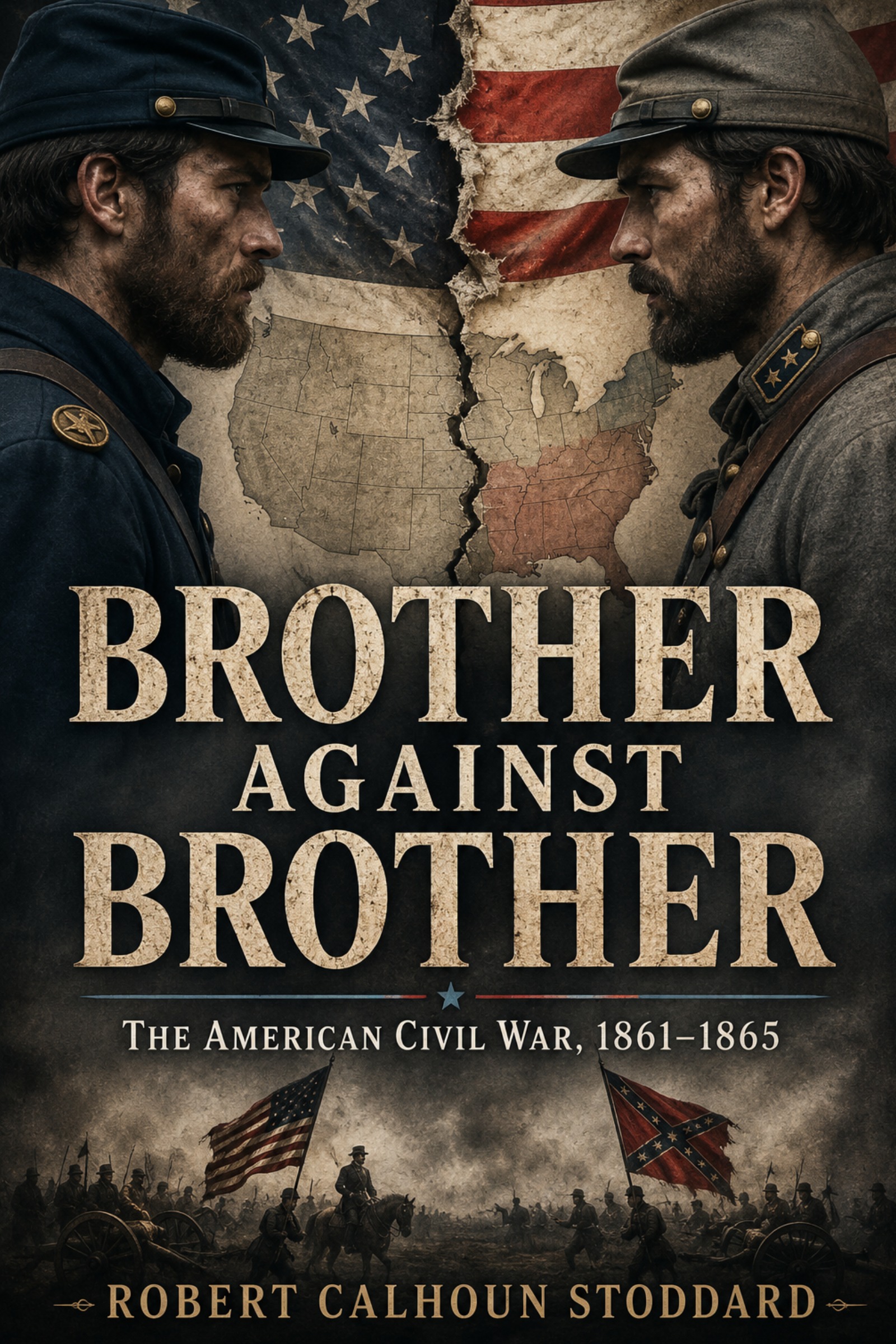
BROTHER AGAINST BROTHER
The American Civil War, 1861–1865
by Robert Calhoun Stoddard
Sign in is required at checkout. You can add to cart anytime.
About this book
At 4:30 a.m. on April 12, 1861, a signal gun fired from Fort Johnson, South Carolina. The shell burst above Fort Sumter. Inside, Major Robert Anderson — a Kentuckian who had owned enslaved people and chose Union loyalty — commanded eighty-five soldiers on reduced rations. The bombardment lasted thirty-four hours. Two men died in a surrender ceremony accident: the first fatalities of a war that would kill 620,000 more.
This is the story of that war — how it came to be fought, how it was fought, and what it left behind. Historian Robert Calhoun Stoddard traces the full arc of the American Civil War from the Missouri Crisis of 1819 through Appomattox, Reconstruction's promise, and the Lost Cause mythology that followed — centering Abraham Lincoln, Ulysses Grant, Robert E. Lee, William Tecumseh Sherman, Frederick Douglass, and the 620,000 dead.
Inside this Civil War history:
- Bleeding Kansas and the collapse of compromise — 5,000 armed Missourians stuffing ballot boxes, John Brown's Pottawatomie killings, and the destruction of the political center (Chapters 1-2)
- Fort Sumter — Lincoln's calculated decision to send only food, maneuvering Jefferson Davis into firing first (Chapter 4)
- Antietam, Gettysburg, and the turning point — the bloodiest single day in American history and the three days in July 1863 that shattered Confederate offensive power and opened the door to the Emancipation Proclamation (Chapters 9, 12)
- Black Americans in the Civil War — Sergeant William Carney holding the 54th Massachusetts flag at Fort Wagner through multiple wounds; 166 United States Colored Troops regiments; Confederate executions of Black prisoners at Fort Pillow (Chapter 15)
- Grant's Overland Campaign and Petersburg — 52,000 Union casualties in five weeks and a nine-and-a-half-month siege that finally broke Lee's army (Chapters 17-18)
- Sherman's March — 62,000 men, 300 miles, $100 million in Confederate property destroyed (Chapter 18)
- The Lost Cause and its costs — how the mythology was built, what it erased, and why the war's questions were not cleanly answered (Chapters 23-24)
The Civil War settled two things: the United States was indivisible, and slavery would not survive. What it left unsettled — whether Black Americans would be full citizens — the next century would contest. This Civil War narrative gives readers the full reckoning: battles, home fronts, Black soldiers, and the long shadow the war cast.
For readers of Shelby Foote's THE CIVIL WAR: A NARRATIVE and James McPherson's BATTLE CRY OF FREEDOM.
Secure checkout. After purchase it’s yours forever — read in your browser on any device.