
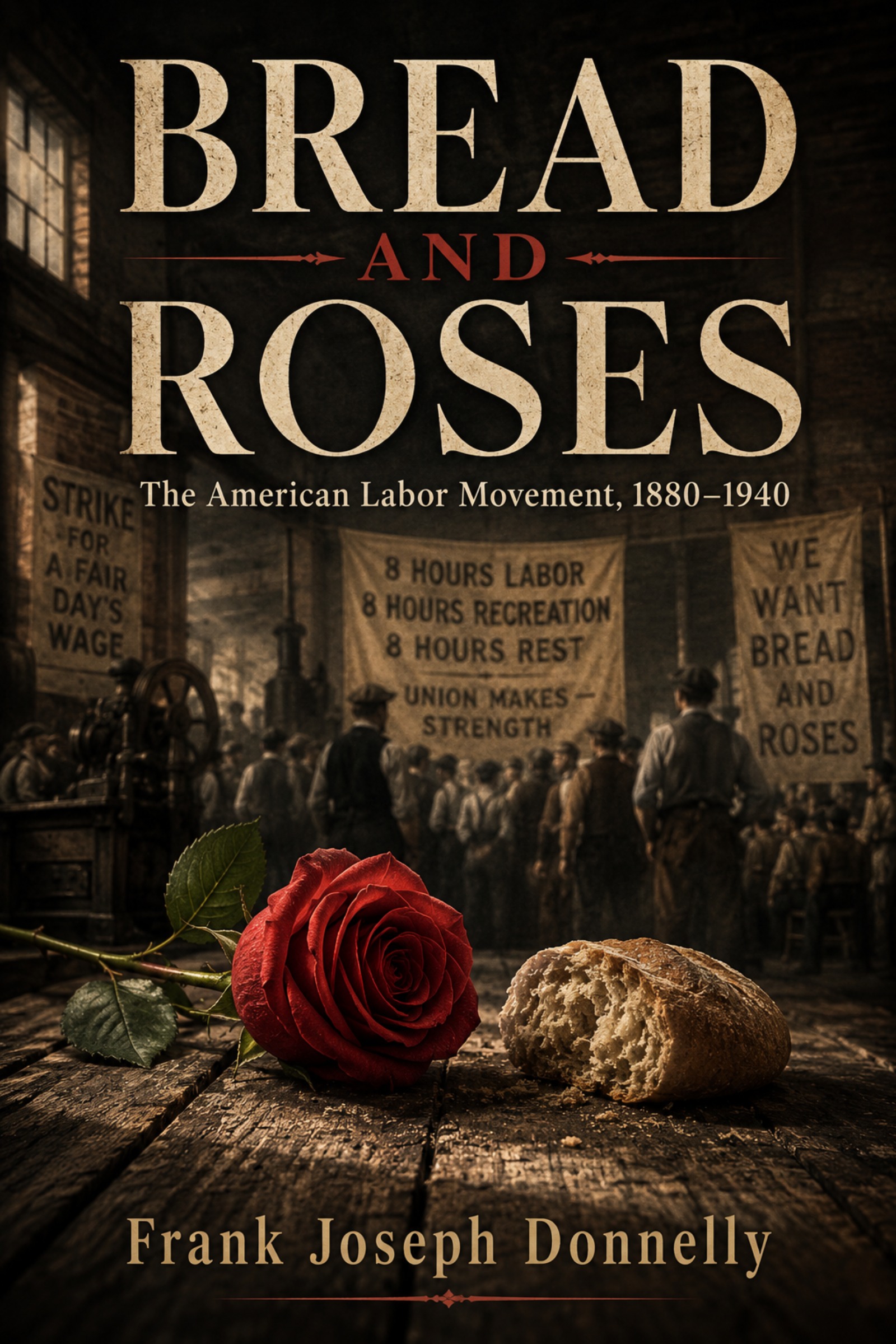
BREAD AND ROSES
The American Labor Movement, 1880-1940
by Frank Joseph Donnelly
Sign in is required at checkout. You can add to cart anytime.
About this book
On March 25, 1911, a fire broke out on the eighth floor of the Asch Building in lower Manhattan. The Triangle Waist Company's exit doors had been locked to prevent unauthorized breaks. In eighteen minutes, 146 people died, 123 of them women. Among the witnesses was Frances Perkins, who would become Franklin Roosevelt's Secretary of Labor and, with legislators Robert Wagner and Alfred E. Smith, transform the tragedy into a generation of factory safety law.
This is the story of how American workers wrested the weekend, the eight-hour day, and the right to bargain collectively from resistant corporations — through strikes, court battles, Pinkerton agents, and National Guard rifles. Historian Frank Joseph Donnelly traces the full arc of American labor from the Knights of Labor, the Homestead massacre, and the Pullman strike through the IWW's Lawrence textile strike, the Red Scare's destruction of radical unionism, and the New Deal's Wagner Act.
Inside this American labor history book:
- The Homestead Strike — Carnegie and Frick's 300 Pinkerton agents against the Amalgamated steelworkers in 1892, the battle on the river, and a defeat that set back industrial unionism for forty years (Chapter 3)
- The Lawrence "Bread and Roses" strike, 1912 — 25,000 workers from 50 nationalities walking out after Polish women discovered their pay envelopes were 32 cents short; IWW organizer Joseph Ettor's multilingual strike committee; and the children's exodus that turned national attention (Chapter 8)
- The Triangle Shirtwaist Fire — the 146 dead, acquitted owners who paid $75 per victim in civil damages, and the Factory Investigating Commission that ran a direct line from locked factory doors in 1911 to OSHA in 1970 (Chapter 6)
- Mother Jones and the Children's Crusade — the 80-year-old organizer who marched child mill workers from Kensington, Pennsylvania to Theodore Roosevelt's door, was arrested by military tribunal, and was buried among the workers killed in the 1898 Virden Massacre (Chapter 18)
- Eugene Debs — sentenced under the Espionage Act in 1918, he received nearly one million votes for president from his cell (Chapter 19)
- The Wagner Act and the CIO's sit-down strikes — John L. Lewis's 1935 AFL punch, U.S. Steel's secret capitulation in early 1937, and the Memorial Day Massacre — Chicago police shooting ten Republic Steel strikers — that secured the moral high ground for industrial unionism (Chapters 13–16)
The eight-hour day, the weekend, child labor laws, workplace safety — these were not gifts from enlightened employers. They were wrested from resistant corporations by workers who refused to yield. The labor movement was always about two things: bread, and roses too. This is the story of how both were won.
For readers of Doris Kearns Goodwin's THE BULLY PULPIT and Erik Larson's THE DEVIL IN THE WHITE CITY.
Secure checkout. After purchase it’s yours forever — read in your browser on any device.